

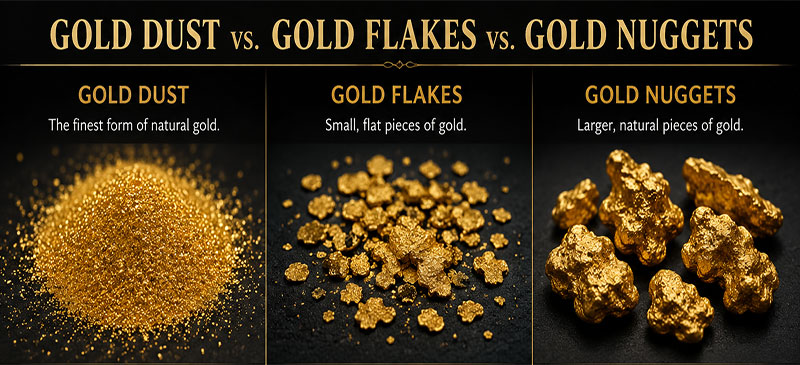
When international buyers approach Orientale Gold Company Ltd. for a bulk purchase, one of the first questions that comes up and rightfully so is: What exactly will I receive? The Democratic Republic of Congo's Orientale province is one of the most mineral-rich territories on earth, and the artisanal and small-scale gold it produces comes in three distinct physical forms: gold dust, gold flakes, and gold nuggets. Each form has different physical characteristics, typical purity levels, handling requirements, and practical implications for the importer.
This guide breaks down each form in plain terms so that bulk buyers whether you are a refinery, a commodity trader, a jewellery manufacturer, or an institutional investor can make fully informed purchasing decisions before any shipment leaves the DRC.
Why the Form of Gold Matters for Importers
Gold is gold in the sense that its intrinsic value is ultimately measured by weight and purity. However, the form in which it arrives affects almost every other dimension of a bulk trade: how it is tested and assayed, how it is weighed, how it is packaged and insured for transit, how local and destination customs classify it, and what processing it requires before it is usable in a refinery or manufacturing pipeline. Receiving the wrong form or receiving one form while expecting another creates costly delays, re-assay expenses, and logistical complications.
From the supply side, the DRC's artisanal mining sector produces all three forms depending on the geology of the specific deposit and the recovery methods used by miners in the field. Orientale Minerals sources from verified, licensed operations across the region and can supply any of the three forms to specification.
Gold Dust: The Finest Form
What It Is Physically
Gold dust refers to extremely fine particles of gold visually resembling a powder or very coarse sand that typically result from alluvial mining. In alluvial (placer) mining, water carries gold particles downstream from primary ore deposits over thousands of years, mechanically breaking them into progressively smaller fragments. The finest of these, once separated from sediment by panning, sluicing, or mercury amalgamation, constitute gold dust.
Individual particles are usually sub-millimetre in size, often invisible to the naked eye as distinct pieces. In bulk, gold dust has a characteristically dull, matte-yellow to bright-yellow appearance depending on purity, and it can be poured like a thick powder. Because of the extremely small particle size, gold dust has a very high surface area relative to its mass, which has implications for handling, contamination, and assay accuracy.
Typical Purity Range
Alluvial gold dust from the DRC typically assays between 85% and 92% fineness (roughly 850–920 parts per thousand, or approximately 20–22 carats) before any refining. The remaining percentage comprises naturally occurring impurities primarily silver, copper, iron, and trace minerals that co-deposit with gold in alluvial environments. Orientale Minerals also supplies gold dust refined to 99.9% purity upon request, suitable for direct investment or high-specification manufacturing use.
Practical Guidance for Importers
Gold dust is the form that requires the most careful handling. Its fine particle size means it can be lost to air movement, static, or moisture absorption during weighing. Accurate assay and weighing must therefore take place in a controlled environment using certified laboratory-grade scales. Shipment packaging must be hermetically sealed typically in double-sealed, tamper-evident plastic bags inside locked containers to prevent both loss and contamination.
From a customs and documentation perspective, gold dust is classified under HS Code 7108.12 (gold in non-monetary, unwrought form) in most jurisdictions. Orientale Minerals provides a Certificate of Origin and a third-party assay report with every shipment.
Gold Flakes: The Mid-Range Form
What It Is Physically
Gold flakes occupy the physical middle ground between dust and nuggets. They are thin, flat, or slightly irregular pieces of gold typically ranging from 1 mm to around 10 mm across that result from the same alluvial process as dust, but represent particles large enough to retain a flattened, leaf-like structure rather than being worn down to powder. They may also result from shallow primary deposits where gold crystallises in thin sheets within quartz or other host rock.
Visually, gold flakes are bright and reflective, often with a characteristic metallic sheen that raw dust lacks. In bulk quantities, gold flakes represent Orientale Minerals' most commonly requested supply form.
Typical Purity Range
DRC gold flakes typically assay between 88% and 95% fineness generally higher than dust from the same region. The relatively larger particle size means they carry proportionally less entrained sediment contamination. Orientale Minerals' gold flakes are available with assay documentation confirming purity, and the company offers access to gold flakes refined to 99.9% purity for buyers requiring investment-grade material.
Practical Guidance for Importers
Gold flakes are arguably the easiest of the three forms to handle in a bulk trading context. They weigh and assay more reliably than dust (less loss during sampling), and they are less fragile than nuggets. For refineries, flakes melt cleanly and consistently, making them efficient feedstock for smelting operations.
Buyers ordering gold flakes should specify whether they want raw, unrefined flakes or pre-refined flakes at a specific fineness. Importers receiving gold flakes should have the shipment re-assayed by their own laboratory upon receipt, as is standard industry practice, and compare results against the seller's Certificate of Analysis.
Gold Nuggets: The Premium Form
What It Is Physically
Gold nuggets are naturally occurring pieces of native gold large enough to be handled as discrete objects typically ranging from roughly 1 gram up to several kilograms in exceptional cases. They form either in primary hard-rock deposits (where gold crystallises directly in quartz veins) or in secondary alluvial deposits where large particles survive the erosion and transport process without being reduced to flakes or dust.
Gold nuggets represent only approximately 2% of all gold recovered globally a natural rarity directly reflected in their market premium. The DRC's Orientale province, with its deep alluvial systems and rich quartz-gold deposits, is one of the world's genuine sources of significant natural nuggets. Orientale Minerals also occasionally supplies crystallised gold, an even rarer sub-category accounting for less than a tenth of one percent of global gold, upon request.
Typical Purity Range
DRC gold nuggets vary in purity depending on their origin. Alluvial nuggets typically assay between 80% and 92% fineness. Hard-rock nuggets can assay higher, occasionally reaching 95% or above, because they have not undergone the same chemical weathering process as alluvial material. Each nugget or lot of nuggets should be individually assayed; unlike dust or flakes, the purity of nuggets is less consistent across a given batch.
Practical Guidance for Importers
Nuggets are the most straightforward form to weigh accurately, since individual pieces can be placed directly on a scale. However, they are the most variable in terms of purity, making individual or sample-based assaying critical. For industrial buyers using nuggets as refinery feedstock, each nugget may need to be crushed or sectioned for representative sampling before accurate purity testing can be performed.
Natural gold nuggets of significant size also carry a collector and aesthetic premium above their melt value. Buyers serving the jewellery, numismatic, or high-end investment markets should communicate minimum weight per piece and preferred surface appearance clearly when placing an order.
| Attribute | Gold Dust | Gold Flakes | Gold Nuggets |
|---|---|---|---|
| Particle Size | Sub-millimetre; powder-like | 1–10 mm; flat, leaf-like | 1 g–multi-kg; discrete solid pieces |
| Typical Raw Purity | 85%–92% | 88%–95% | 80%–95% (variable per piece) |
| Refined Purity Available | Up to 99.9% | Up to 99.9% | Varies; assay per lot required |
| Weighing Reliability | Moderate (risk of loss) | High | High (purity inconsistent) |
| Best Suited For | Refineries; industrial smelting | Refineries; manufacturing; investment | Collectors; jewellery; premium investment |
| Assay Method | Fire assay on representative sample | Fire assay or XRF on sample | Individual or sectioned-sample assay |
| Market Rarity | Abundant in alluvial regions | Common in alluvial/shallow primary deposits | Rare (~2% of global gold recovered) |
| Packaging | Hermetically sealed double bags | Sealed, tamper-evident containers | Individual pouches + secure container |
Documentation Every Importer Should Expect
Regardless of which form you order, a reputable DRC gold supplier should provide a consistent documentation package with every bulk shipment. At Orientale Minerals, standard documentation includes: a Certificate of Origin confirming the gold's provenance from licensed mining operations in the DRC; a third-party assay report specifying purity and weight; an export permit issued under DRC mining law; and a commercial invoice and packing list compliant with international trade requirements. For buyers in regulated markets the EU, UK, UAE, or the United States additional conflict-mineral compliance documentation may be required, and Orientale Minerals can facilitate this.
Importer's Tip: Always request that the assay report be issued by an internationally accredited laboratory (ISO/IEC 17025 certified) rather than an in-house supplier test. This is standard practice in responsible gold trade and protects both parties in the event of a purity dispute.
Which Form Is Right for Your Buying Purpose?
If you operate a refinery or smelting facility: Gold flakes are typically the most practical feedstock consistent particle size, reliable weighing, and clean melting behaviour. Gold dust is equally acceptable if your facility is equipped to handle fine particulate materials.
If you are a commodity trader or bullion dealer: Pre-refined gold flakes or dust at 99.9% fineness provide the most straightforward pricing, aligning directly with LBMA-recognised purity standards and allowing spot-market pricing.
If you supply the jewellery manufacturing sector: Gold flakes at 22–24 carat purity are the most commonly used raw input. Higher-purity material (99.9%) is preferred for alloying to precise specification.
If you serve the collector, numismatic, or premium investment market: Gold nuggets especially larger, well-formed specimens command a premium that can substantially exceed their weight-based value. Clear provenance, photographic documentation, and size consistency are the key value drivers.
A Note on "Raw Gold" vs. Refined Gold
Orientale Minerals' product range includes a category called "Raw Gold" alongside Gold Flakes and Gold Nuggets. Raw gold simply refers to gold in its unprocessed, as-mined state which may be any of the three physical forms described above before any refining, smelting, or processing has taken place. Raw gold is typically priced at a discount to refined gold to account for the buyer's refining costs and the purity uncertainty inherent in unprocessed material.
Trusted DRC Gold Supplier
✉ Email
orientalegold@gmail.com
Working with Orientale Minerals as Your DRC Supplier
Orientale Gold Company Ltd. is a licensed gold mining and export company operating out of Buta, Kasai-Oriental, in the Democratic Republic of Congo, with a network extending across Uganda, Kenya, Ghana, Zambia, South Sudan, and Sierra Leone. The company holds a formal mining lease and operates under DRC mining law with full export authorisation.
For bulk buyers, Orientale Minerals can supply gold dust, gold flakes, and gold nuggets in quantities ranging from small investment parcels to multi-kilogram commercial lots. All shipments are accompanied by a full documentation package. Contact the team to discuss form, purity, weight, packaging specifications, and pricing.


